

Scholar Research Update - Elizabeth Schrader Polczer
What are scholars of early Christianity looking for these days? What’s on their minds? Shirley Paulson's "Scholar Research Updates" will help you keep up with current research.
Elizabeth Schrader Polczer (Interview June 2026)
What are your most recent publications?
Forthcoming: An Abundant Bouquet: Narrative Variants in the Gospels.
Elizabeth Schrader Polczer’s dissertation monograph is currently in press with Society of Biblical Literature Press Text Critical Studies.
2025: “’An Image of Eternal Incorruptible Light’: P.Oxy 5577 as a Possible Fragment of the Gospel of Mary,” Journal of Early Christian Studies
The 2025 JECS article argues that P.Oxy. 5577 may be a piece of the missing “vision” section of the Gospel of Mary. Just a few months before, a very similar argument was published by Sarah Parkhouse; we wrote simultaneously and independently of one another, and arrived at very similar conclusions. Although we can’t be certain, the fact that two experts independently came to the same conclusion strengthens the likelihood that this papyrus fragment is indeed a section of the Gospel of Mary. The main difference between our arguments is that my JECS article argues that Wisdom of Solomon 7 (a hymn praising Lady Wisdom) may have been one of the primary inspirations for the composition of the Gospel of Mary.
Please share a little about the book.
An Abundant Bouquet: Narrative Variants in the Gospels is a close study of “narrative variants” preserved in copies of ancient New Testament gospel manuscripts. Narrative variants are textual variations in ancient manuscripts that create meaningful changes to the story itself (i.e. changes of word order, spelling, or substitution of similar words are not included). In antiquity every copy was made by hand, so even texts understood to hold sacred status were always susceptible to meaningful change.
Although New Testament textual criticism has traditionally sought to recover a singular text of the gospels, this study argues that early Christianity was in fact centered in an environment of interpretive expansions and editorial revisions, rendering such a recovery impossible in many passages. Gospel stories could be altered by a single letter, a single word, an added or omitted phrase, an altered phrase, a rewritten section, or the revision of an entire book.
The narrative variants highlighted here are limited to those preserved in gospel manuscripts copied no later than the fifth century.
The book concludes that a wide variety of forms of gospel stories were understood as sacred in the first centuries of Christianity, that narrative multiplicity is inherent to the Christian gospels, and that this multiplicity should be embraced by Biblical scholars. The book also provides a comprehensive Appendix cataloguing the approximately 1,900 narrative variants in all extant gospel manuscripts from the 2nd-5th centuries.
Can you provide us with a summary of the article?
A previously-unknown Christian text published in the 2023 volume of the Oxyrhynchus Papyri series preserves a fragmentary dialogue where a woman named Mary is apparently instructed by Jesus. Although the fragment is brief and lacunose, it contains emphases on the “good,” the “mind,” and intertwined and dissolved elements, themes which are also prevalent in the extant portions of the Gospel of Mary. Due to this shared content, as well as narrative sensibility, this study explores the question of whether P.Oxy. 5577 might preserve a portion of Mary’s vision from the Gospel of Mary.
Regardless of whether P.Oxy. 5577 is a portion of the Gospel of Mary, this study underlines several intriguing parallels with second-century Christian beliefs preserved in Irenaeus, Clement of Alexandria, and Celsus. Moreover, the description of Mary becoming an “image of eternal incorruptible light” seems to reference Wisdom of Solomon 7, opening up the possibility that this fragment provides instructions for how Mary might become a “holy soul” who receives God’s “intelligent spirit” of wisdom.
Are there any reviews or responses you’d like to mention?
The book hasn’t come out yet, so no responses to that one.
As for the JECS article, thus far people have been quite receptive to the possibility that P.Oxy. 5577 is a piece of the Gospel of Mary. When I interviewed Mark Goodacre for The Christian Century, he did provide this important counterpoint: “The thing that makes me cautious is that it has the Matthean-sounding ‘Therefore I say to you’ twice, and for such a tiny fragment that is striking since the expression does not come anywhere else in what we have of the Gospel of Mary. Also, we have ‘incorruptible light’ and ‘incorruptible Father’ in the fragment, as well as a second ‘Father’ but we don’t have any of that vocabulary in what we have of Gospel of Mary. These are not decisive points, especially when dealing with such a small fragment, but they are enough to make me pause.”
What idea or question has most intrigued you lately?
I am really enjoying working with the concept of narrative variants. Gospel stories have always been pluriform, not just from Matthew to Mark to Luke, but sometimes even from manuscript to manuscript of the same gospel. Often people try to minimize them, but these variations can create real interpretive consequences (For example, in two of the oldest copies of Mark’s Gospel, Salome is not present at the empty tomb. What is up with that? Obviously multiple versions of the story were circulating from the very beginning).
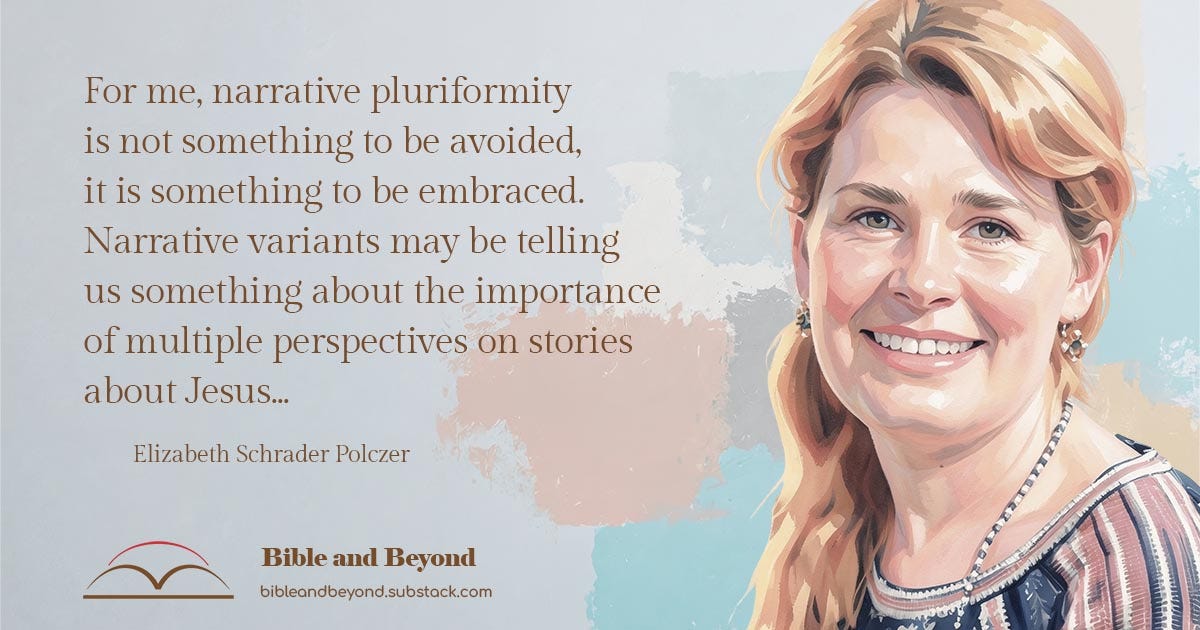
For me, narrative pluriformity is not something to be avoided, it is something to be embraced. Narrative variants may be telling us something about the importance of multiple perspectives on stories about Jesus; there might even be something theological about communities altering the text to meet their own needs.
What would you like to explore next?
For my next book project, I am continuing to think about the ramifications of narrative variants. In particular I am interested in exploring the relationship between the differing versions of the Gospel of John that circulated in the second century and apocrypha like the Gospel of Mary and the Gospel of Philip. Alternate circulating text forms of John may explain some of the prominent characterizations of a disciple named “Mary” that we find in these apocryphal texts.
Any recent updates you’d like our readers to know about?
I’m pleased to share that my research on Martha’s inconsistent presence in John 11 and 12 has resulted in an update to the apparatus of the Nestle-Aland 29th Novum Testamentum Graece. NA29 is scheduled to be available for purchase at SBL in Denver, and readers will see that the footnotes look very different in John 11. I will be discussing these updates to the NA29 apparatus at the Johannine Literature section.