

Who’s Who in Early Christian History: Philo of Alexandria
The Jewish Thinker Who Helped Shape Christian Thought
When people think about the intellectual roots of Christianity, they usually turn first to the Hebrew Bible, the teachings of Jesus, or perhaps the letters of Paul. But standing quietly in the background of all these developments is a remarkable Jewish thinker from Alexandria: Philo.
Philo never became a Christian. In fact, he died before Christianity had fully emerged as a distinct movement. Yet his influence on Christian thinking may be difficult to overstate. He helped create a bridge between Jewish scripture and Greek philosophy that later Christian writers would eagerly cross.
Born in Alexandria, Egypt, around 20 BCE and dying about 50 CE, Philo lived in one of the most intellectually vibrant cities of the Roman world. Alexandria was famous for its libraries, philosophical schools, and religious diversity. Jews, Greeks, Egyptians, and Romans all interacted there. Philo himself was deeply devoted to Judaism, especially to Moses and the interpretation of Genesis, but he was equally immersed in Greek philosophical traditions, particularly Plato and the Stoics.
His great project was ambitious: to show that Jewish scripture and Greek philosophy ultimately pointed toward the same truths.
To accomplish this, Philo interpreted biblical stories allegorically. Rather than reading Genesis simply as historical narrative, he treated it as a spiritual and philosophical text that concealed deeper truths about humanity, the soul, and God.
This method became enormously important for later Christian interpreters.
Reading Genesis Through Philosophy
One of Philo’s most influential ideas involved the opening chapters of Genesis. He noticed that Genesis contains two different creation accounts. Rather than seeing these accounts as a contradiction, he interpreted them as descriptions of two different levels of reality. In his reading, Genesis 1 describes the creation of a heavenly or ideal human being made in the image of God, while Genesis 2 describes the earthly human formed from dust.
That distinction between heavenly and earthly humanity later became central in several Christian, including gnostic, traditions. Scholars have long noticed parallels between Philo’s interpretation and writings such as the Secret Revelation of John, where Genesis is reread as both material and spiritual descriptions of creation.
Philo was also fascinated by the human nous, or higher mind. For him, the divine breath placed into Adam was not merely biological life but a spiritual capacity for perceiving God. As Esther DeBoer summarized Philo’s interpretation of Genesis 2:7, God transformed humanity “from a dull and blind soul into a spiritual and truly living being by blowing the life-giving Spirit into his nous” (Gospel of Mary: Listening to the Beloved, 2004).
This language sounds strikingly familiar to readers of later Christian spiritual/mystical writings. Early Christians would increasingly speak about spiritual rebirth, illumination, and awakening to divine reality. Philo helped prepare the intellectual framework for those ideas.
The Logos and the Gospel of John
Perhaps his most famous contribution was his development of the concept of the Logos.
The Greek word “logos” can mean “word,” “reason,” or “principle.” Philo used it to describe the intermediary between the utterly transcendent God and the material world. God, in Philo’s understanding, was too exalted and incomprehensible to interact directly with matter. The Logos therefore became the divine instrument through which creation and revelation occurred.
It is impossible not to think here of the opening of the Gospel of John: “In the beginning was the Word [Logos].”
Whether the author of John directly depended on Philo remains debated. But both emerged from the same Alexandrian and Hellenistic intellectual environment where the Logos had already become a powerful theological concept.
Philo’s influence extended even further. Christian writers such as Justin Martyr later adopted his allegorical approach to scripture, reinterpreting Jewish texts in increasingly Christ-centered ways. Other Christian thinkers also inherited Philo’s interest in ascent to God (Clement of Alexandria), the purification of the soul (ascetics), and the pursuit of divine knowledge (Origen).
Ascent, Mysticism/Spirituality, and the Soul
Yet Philo himself was not a visionary mystic in the same sense as later writers with gnostic views. As Harvard scholar Harold Attridge observed, Philo was fundamentally an interpreter. He was interested in how human beings could perceive the unknowable God through contemplation, virtue, and disciplined understanding.
Still, his writings often move close to mystical/spiritual experience. He described moments in which the soul ascends beyond ordinary perception and encounters divine reality through vision and insight. He drew on stories such as Jacob’s ladder, Moses on Sinai, and Abraham standing before God as symbols of humanity’s longing to approach the divine.
For Philo, however, the ultimate divine reality always remained partly beyond human comprehension. God could be approached through his “powers,” but never fully grasped.
Another fascinating aspect of Philo’s thought is the way he combined Jewish scripture with Platonic philosophy. Plato had described a world of eternal Forms or Ideas beyond the changing material world. Philo used this philosophical framework to reinterpret Genesis itself. The earthly realm became transient and unstable, while the higher spiritual realm represented enduring truth.
This distinction profoundly influenced later Christian spirituality. It shaped ideas about immortality, heavenly ascent, the soul’s liberation from passions, and even the contrast between flesh and spirit found throughout early Christian literature.
Some later Christian writers (again, including those who wrote on gnostic goals) pushed these ideas much further than Philo himself likely intended. While Philo emphasized the spiritual dignity of the human mind, he stopped short of identifying the human self as fully divine. Later gnostic thinkers would cross that line much more boldly.
A Forgotten Architect of Christian Thought
Even so, Philo’s fingerprints remain everywhere.
His allegorical reading of Genesis influenced Christian theology. His Logos theology shaped discussions of Christ and creation. His understanding of spiritual ascent informed later mystical traditions. His attempts to unite Jewish scripture with Greek philosophy helped create the intellectual environment in which Christianity itself developed.
Ironically, Philo—the Jew—had relatively little lasting influence within Judaism. Rabbinic Judaism moved in different directions after the destruction of the Jerusalem Temple in 70 CE. Christians, however, eagerly preserved and copied his writings for centuries.
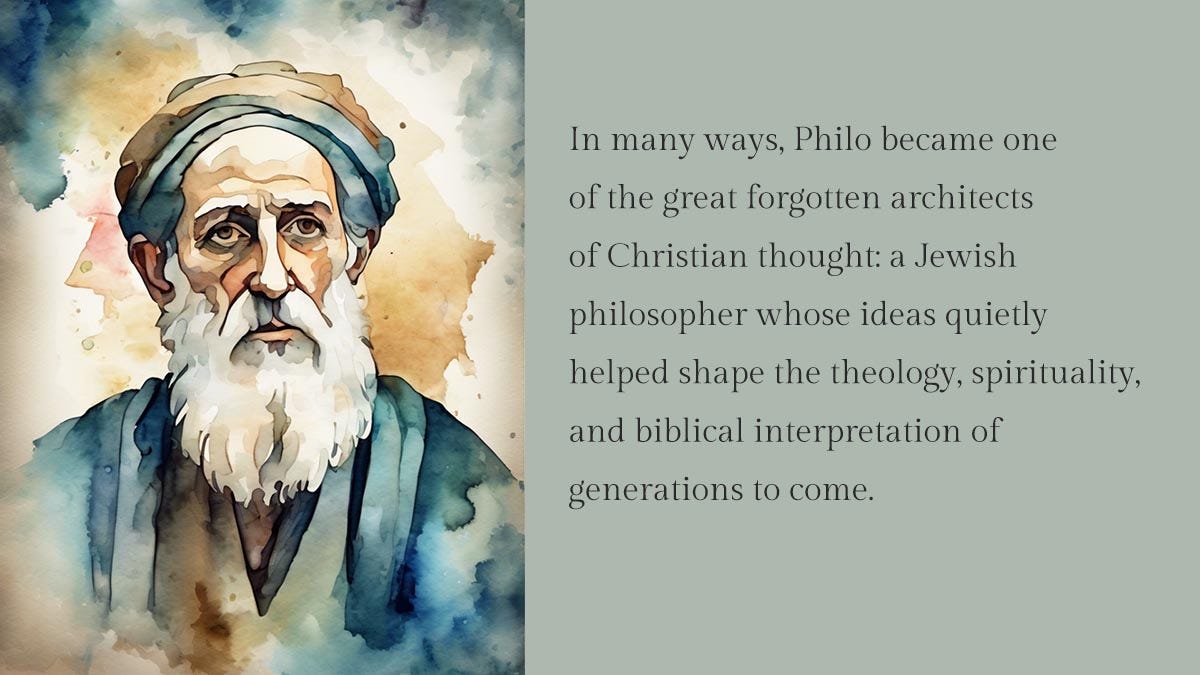
In many ways, Philo became one of the great forgotten architects of Christian thought: a Jewish philosopher whose ideas quietly helped shape the theology, spirituality, and biblical interpretation of generations to come.
Thank you for (yet again) helping clear away some of the mud that has plagued the evolution of Christianity for centuries (and maybe Judaism? And maybe Islam?). Today, the Christian Science Monitor carried an article reporting the strong resurgence of young people's interest in buying and reading the Bible. Surely Bible & Beyond is playing its part.
Thank you for this article on Philo...totally expanding my thoughts on the past philosophic writers. I'm so glad that time has not destroyed these works and that people have still studied and made them available to otherwise focussed but interested individuals like me. Thank you