

Book Review: God's Ghostwriters by Candida Moss
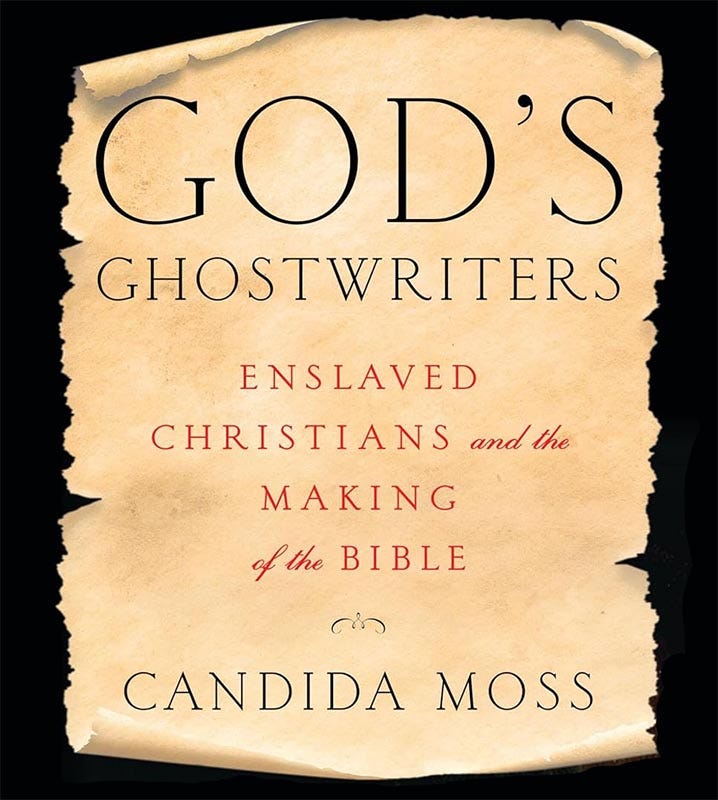
Moss, Candida. God’s Ghostwriters: Enslaved Christians and the Making of the Bible. Little, Brown and Company, New York, 2024. (317 pages)
God’s Ghostwriters: Enslaved Christians and the Making of the Bible
by Candida Moss
Short Annotation
Candida Moss’s God’s Ghostwriters challenges readers to reconsider the origins of the New Testament by highlighting the hidden role of enslaved people in its production, transmission, interpretation, and performance. Moss argues that enslaved workers were not merely background laborers but essential contributors whose experiences shaped early Christian meaning itself. Through vivid storytelling grounded in historical evidence, she reconstructs the lives of enslaved children, secretaries, copyists, messengers, readers, martyrs, and other largely invisible figures behind the Christian tradition.
The book progresses from the education of literate enslaved workers and the association of crucifixion with slavery to broader reflections on how Jesus traditions, apostolic missions, and textual transmission were embedded within the realities of enslavement. Particularly powerful are Moss’s discussions of Blandina, the enslaved martyr whose endurance transformed her into a model of Christian faithfulness, and the terrifying punishments endured by enslaved people whose suffering later shaped Christian images of hell.
Moss ultimately argues that continuing to erase enslaved workers distorts our understanding of Christianity itself. By recovering their labor, pain, intelligence, and endurance, God’s Ghostwriters offers a compelling reexamination of who made the Bible possible and whose experiences shaped its meaning.
Full Review
Candida Moss boldly asserts that “it is not just enslaved work that made the Bible possible: it is enslaved personhood that gave it meaning and brought it to life” (16). For Bible readers who conceive their sacred scriptures as a direct message from God to the written page—or even solely through the apostles of Jesus—Moss’s assertion that enslaved people contributed so much to the making of the Bible can be jarring.
Yet through vivid storytelling supported by historical documentation, Moss makes a compelling case for rethinking both the nearly invisible enslaved people of antiquity and our assumptions about sacred scripture itself. The arrangement of the chapters contributes to the persuasive force of her argument. Each chapter moves the reader deeper into the hidden world of enslaved workers—not only as producers of texts, but also as interpreters, messengers, performers, and even embodiments of the Christian message.
Her opening story introduces Alexamenos, an enslaved child whose classmate mocked him with a drawing of a donkey-headed man on a cross (i.e. a mockery of Jesus). Part historical reconstruction and part imaginative retelling, the episode illustrates the first chapter’s larger point: enslaved children were often educated in order to become literate workers for their enslavers. Contrary to later American assumptions that literacy threatened systems of slavery, education in antiquity could increase an enslaved child’s economic value and usefulness.
The drawing of Alexamenos’s classmate also highlights another major theme running throughout the book: crucifixion and danger belonged to the world of enslaved people. Crucifixion was a Roman punishment especially associated with the lowest social classes, and the classroom scene poignantly illustrates how naturally crucifixion and enslavement were linked in the ancient imagination.
From this point onward, Moss steadily immerses the reader in the visceral realities of enslaved life. Yet, as she notes, “enslaved literate workers are everywhere and nowhere in our sources” (49). They were essential for taking dictation, copying manuscripts, transporting texts, and interpreting them, even while remaining largely invisible in historical memory.
The next chapter, focused on Paul and his secretaries, pushes the argument further. Moss explores the paradox of educated enslaved workers who moved among Christian communities while possessing no agency of their own. Their literacy existed for the benefit of their enslavers, not themselves. Here Moss adds another layer to the discussion of physical labor and raises the unsettling suggestion that enslaved workers may also have shaped the interpretation and transmission of Christian texts.
The following chapter, “Rereading the Story of Jesus,” expands the argument further by examining Jesus traditions through the social realities of enslavement. Moss asks provocative questions about the vulnerability of Jesus’s family within the Roman world and demonstrates how deeply Jesus’s teachings and parables reflect familiarity with servile life. The suggestion that Jesus himself was remembered in language associated with servitude becomes increasingly uncomfortable for readers accustomed to emphasizing divine majesty over social degradation.
As I allowed myself to identify with Moss’s stories, I recognized how my own life, in a world far safer and with a large degree of my own agency, has blinded me to this image of Christianity born in the context of enslavement.
As the book progresses, Moss broadens her focus from the production of texts to their missionary circulation and performance. Part II introduces “messengers of God,” “curators of the Word,” and “faces of the Gospel”—enslaved workers whose contributions shaped not only the spread of Christianity but also the meaning of its scriptures.
In the chapter on messengers, Moss turns to the apostle Thomas, who according to later tradition was sold by Jesus as a carpenter to an Indian merchant. Whether historically factual or not, the story from the Acts of Thomas reflects the lived realities of trafficking, displacement, and vulnerability familiar to enslaved people throughout the Roman world. Thomas becomes a “slave of God,” carrying the Christian message without social protection, financial independence, or security from abuse. Moss argues that such stories resonated because they reflected recognizable social realities.
The chapter on textual curators brings copyists out from the shadows. Although ancient elites often disparaged copyists, Moss demonstrates that they functioned as important textual interpreters. These enslaved workers constantly made decisions about wording, spelling, placement, and meaning. The theological controversies later generated by textual variants often obscured the fact that the earliest interpretive decisions may have been made by workers whose names were never preserved.
Similarly, the chapter on the “faces of the Gospel” reminds readers that people usually experienced Christian manuscripts publicly rather than silently and privately. Educated enslaved readers performed texts aloud before communities, and their success—or failure—depended upon the accuracy and persuasiveness of their delivery. In this sense, enslaved readers became living mediators of scripture itself.
Throughout these chapters, the emotional and physical realities of enslaved existence become increasingly vivid. Modern readers can recognize the crushing exhaustion, lack of personal autonomy, constant vulnerability, and absence of hope that shaped everyday life for many enslaved people.
At this point, Moss turns toward two especially painful chapters: “The Faithful Christian” and “Punishing the Disobedient.” Here the book reaches its emotional and theological climax.
The chapter on faithful Christians centers on Blandina, the second-century enslaved martyr. By now, readers have become accustomed to the dehumanization and brutality inflicted upon enslaved workers, but Blandina’s story gives profound emotional depth to the earlier discussions. Regular verbal abuse and casual beatings had already conditioned her body and spirit long before her public torture began. Yet her tormentors underestimated her endurance. After surviving unimaginable torture throughout an entire day, she was suspended in cruciform form before finally dying in the arena. Moss writes, “She whom society had deemed worthless was now a model for others—an enslaved Christian who led other Christians, an enslaved woman who was filled with power” (204). Blandina becomes one of Moss’s clearest examples of how people considered socially disposable helped define Christian ideals of faithfulness, endurance, and spiritual authority.
Reading of the injustice of Blandina’s mistreatment in her young years of servitude, followed by every abuse humans can manufacture, roused moral indignation in me.
Moss’s final brief chapter is perhaps the most disturbing. She traces how the suffering of enslaved people eventually shaped Christian imaginations of hell itself, influencing later writers such as Dante. As throughout the book, she combines historical evidence with literary traditions rooted in recognizable social realities. One especially horrifying story concerns Euclia, likely a young enslaved girl caught in the tensions of her enslaver’s failing marriage. Tortured, mutilated, and abandoned in darkness, her story exposes the terrifying vulnerability of enslaved people whose suffering could be interpreted as justified punishment for disobedience.
Moss’s epilogue helpfully restores the broader focus of the book. Readers have long been conditioned to imagine the New Testament primarily as the work of apostles, evangelists, and church leaders. Moss does not deny their importance, but she insists that continuing to erase invisible workers ultimately distorts our understanding of how Christian scripture came into being. By recovering the experiences of servile workers—their labor, pain, intelligence, and interpretive contributions—she challenges readers to rethink not only who made the Bible possible but also whose experiences shaped its meaning.
God’s Ghostwriters is ultimately more than a history of enslaved labor behind biblical texts. It is a powerful reconsideration of whose voices have been hidden within Christianity from the very beginning.
Read more reviews:
Available on Amazon or order from your local bookstore.